How to Build a Memecoin Portfolio from Scratch: Complete Beginner’s Guide (2026)
How to Build a Memecoin Portfolio from Scratch: Complete Beginner’s Guide (2026)
Building your first memecoin portfolio feels overwhelming. Hundreds of tokens exist on Solana alone, each promising massive returns. Most beginners make critical mistakes: investing too much in a single token, following hype without research, or panic-selling during normal market corrections.
This comprehensive guide walks you through building a balanced memecoin portfolio step-by-step. You’ll learn exactly how much capital to start with, which tokens to choose, how to allocate percentages, and when to rebalance. By the end, you’ll have a systematic approach that manages risk while capturing upside potential.
What you’ll learn:
- Minimum starting capital and realistic expectations
- How to research and select quality memecoins (not just hype)
- Optimal number of tokens to hold (3-7 sweet spot explained)
- Allocation strategies for beginners (before learning advanced optimization)
- Wallet setup and security fundamentals
- When and how to rebalance your portfolio
- Common beginner mistakes and how to avoid them
Understanding Memecoin Investing: What Makes It Different
Memecoins differ fundamentally from traditional cryptocurrencies like Bitcoin or Ethereum. Bitcoin serves as digital gold with a $1 trillion market cap and institutional adoption. Ethereum powers decentralized applications with real utility and network effects.
Memecoins, however, derive value primarily from community sentiment, viral marketing, and speculative demand. This creates both opportunity and risk that beginners must understand before investing.
Key Characteristics of Memecoin Markets
Extreme volatility: Memecoins commonly experience 20-50% daily price swings. A token can double in hours or lose half its value just as quickly. Traditional stocks move 1-2% daily; memecoins operate on a completely different scale.
Narrative-driven cycles: Prices respond to social media trends, influencer endorsements, and community momentum rather than earnings reports or technical fundamentals. Understanding these narratives helps you time entries and exits.
High correlation during crashes: When Bitcoin drops sharply, nearly all memecoins fall together regardless of individual merits. Diversification provides less protection than in traditional markets during systemic crypto downturns.
Rapid token launches: New memecoins launch daily on Solana. Most fail within weeks, but a few achieve lasting success. According to CoinGecko data, over 90% of new token launches fail to maintain trading volume after 30 days.
Why Memecoins Require Different Portfolio Strategies
Traditional 60/40 stock-bond portfolios or even standard crypto portfolios (BTC/ETH heavy) don’t translate to memecoin investing. The extreme volatility demands specialized risk management approaches.
Position sizing matters more: A single overlarge position can destroy your portfolio during a crash. Even promising tokens can drop 80-90% from peaks, making position limits critical.
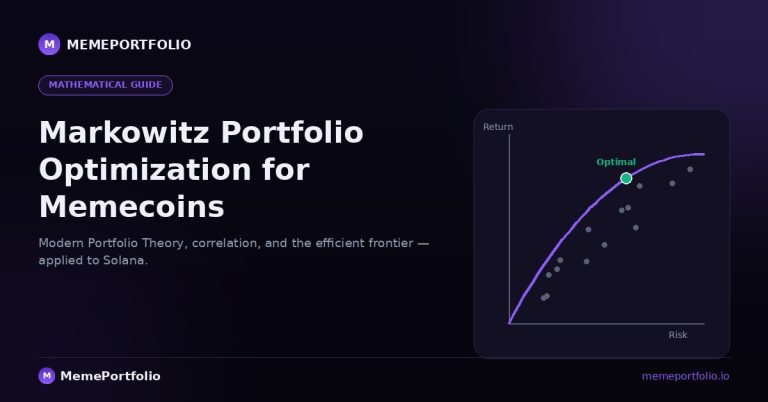
Correlation analysis is essential: Buying five different dog-themed memes doesn’t provide diversification—they move together. True diversification requires selecting tokens with different narratives and community bases, as explained in our Markowitz optimization guide.
Rebalancing frequency increases: Unlike quarterly stock rebalancing, memecoin portfolios may need monthly or even weekly attention during volatile periods. Our rebalancing guide covers optimal frequencies in detail.
Step 1: Determine Your Starting Capital
The first critical decision is how much money to allocate to memecoins. This isn’t about finding spare change—it requires honest financial assessment and risk tolerance evaluation.
The Absolute Minimum Rule
Only invest money you can afford to lose completely. This isn’t standard investment disclaimer language—it’s a practical reality with memecoins. Even established tokens like BONK or WIF have experienced 70-80% drawdowns from peaks.
Calculate your “risk capital” using this framework:
| Financial Situation | Maximum Memecoin Allocation | Reasoning |
|---|---|---|
| No emergency fund | $0 | Build 3-6 months expenses first |
| Emergency fund only | 1-2% net worth | Experimental allocation, learning phase |
| Emergency fund + retirement on track | 3-5% net worth | Moderate risk-taking appropriate |
| Strong financial foundation | 5-10% net worth | Can absorb total loss without lifestyle impact |
| High risk tolerance + experience | 10-20% net worth | Aggressive allocation, requires active management |
Practical Starting Amounts by Experience Level
Complete beginner ($500-$1,000): This amount allows meaningful learning without devastating losses. You can hold 3-4 positions with $150-$300 each, enough to feel real market movements but small enough to sleep at night.
Some crypto experience ($2,000-$5,000): Familiar with wallets and exchanges? This range lets you build a properly diversified portfolio of 5-7 tokens. Transaction fees become negligible relative to position sizes.
Experienced investor ($5,000-$25,000): Already profitable in crypto markets? Larger capital enables advanced strategies like rebalancing, tactical allocation adjustments, and mathematical optimization covered in our portfolio optimization guide.
According to Investopedia’s risk management principles, never allocating more than 5-10% of your portfolio to highly speculative assets remains sound advice even in crypto markets.
💡 Ready to Build Your Portfolio?
Once you’ve selected your tokens and determined allocations, MemePortfolio.io calculates mathematically optimal percentages using Markowitz optimization. Stop guessing at allocations—get data-driven recommendations in seconds.
Step 2: Set Up Your Solana Wallet Securely
Before buying any memecoins, you need a secure Solana wallet. Unlike exchanges where platforms control your crypto, non-custodial wallets give you complete ownership—and complete responsibility for security.
Recommended Wallet Options
Phantom Wallet (Recommended for beginners): User-friendly interface, browser extension and mobile app, built-in swap functionality. Over 3 million active users make it the most popular Solana wallet.
Solflare: Advanced features for experienced users, hardware wallet integration, staking capabilities. Better for larger portfolios requiring extra security.
Backpack: Newer wallet with clean design, strong security features, growing ecosystem integration. Good alternative to Phantom with similar ease of use.
Critical Security Steps (Never Skip These)
Write down your seed phrase physically: Never store your 12-24 word recovery phrase digitally. Use paper or metal backup plates. Anyone with this phrase controls your funds permanently—no recovery options exist if lost.
Test with small amounts first: Send $10-20 of SOL to your new wallet before transferring larger amounts. Confirm you can send, receive, and swap tokens. This test costs pennies but prevents costly mistakes.
Enable all security features: Use biometric authentication, set up transaction confirmations, enable app passwords. According to FTC guidelines on digital security, multi-layer protection significantly reduces theft risk.
Beware of fake wallet apps: Only download from official websites. Scammers create copycat apps that steal seed phrases. Verify URLs carefully: phantom.app, solflare.com, backpack.app are legitimate.
Step 3: Research and Select Your First Memecoins
Choosing which memecoins to buy separates successful portfolios from disasters. Random selection based on Twitter hype leads to losses. Systematic evaluation increases your odds dramatically.
The Selection Framework: 6 Key Criteria
Evaluate each potential token across these dimensions before investing. Not every token will score perfectly, but avoid any with multiple red flags.
1. Community Strength and Engagement
Check Twitter followers, but more importantly, engagement rates. A token with 50,000 followers and 5% engagement beats 200,000 followers with 0.5% engagement. Active communities sustain prices through corrections.
Visit Discord or Telegram groups. Are members discussing the project actively? Do developers respond to questions? Ghost towns indicate dying projects regardless of market cap.
2. Development Activity
Even pure memecoins benefit from active teams. Check for recent announcements, partnership reveals, exchange listings in progress. Tokens with quarterly updates outperform those with radio silence.
GitHub activity matters for tokens claiming utility. Weeks without commits suggest abandoned development. Our best memecoins guide ranks tokens partially on development metrics.
3. Tokenomics and Supply Distribution
Examine total supply, circulating supply, and team allocations. Red flags include:
– Team holds >30% of supply
– Massive unlocks scheduled (future sell pressure)
– No burn mechanism with infinite inflation
– Top 10 holders control >60% (manipulation risk)
Use Solscan to research holder distribution and token details for any Solana memecoin.
4. Liquidity and Exchange Availability
Can you actually sell if needed? Check 24-hour trading volume. Minimum $500,000 daily volume allows reasonable position sizes without severe slippage.
Major exchange listings (Binance, Coinbase, Kraken) signal legitimacy and provide exit liquidity. DEX-only tokens after 6+ months raise concerns about listing barriers.
5. Narrative Strength and Differentiation
What story does this token tell? First dog meme on Solana (BONK) had narrative power. The 47th dog token copying the same playbook doesn’t.
Strong narratives: gaming integration, charity tie-ins, cultural moments, first-mover in categories. Weak narratives: generic copycat, forced memes, no unique angle.
6. Risk Indicators and Red Flags
Has the token been audited? Any exploit history? Search “[token name] hack” or “[token name] scam” to uncover past issues. Clean audit from reputable firms (CertiK, Hacken) reduces smart contract risk.
Beware of:
– Anonymous teams with no track record
– Unrealistic promises (“guaranteed 100x”)
– Aggressive marketing without substance
– Pressure to “buy now before it’s too late”
Recommended Starting Tokens for Beginners (2026)
These established Solana memecoins provide good starting points for first-time investors. They have proven track records, strong communities, and reasonable liquidity.
| Token | Why Consider | Risk Level | Beginner-Friendly? |
|---|---|---|---|
| BONK | Largest Solana memecoin, broad distribution, major exchange listings | Lower (for memecoins) | Yes – most stable option |
| WIF | Viral narrative, strong community, high liquidity | Medium-High | Yes – proven track record |
| MYRO | Development focus, staking utility, Solana founder connection | Medium | Yes – utility provides floor |
| POPCAT | Gaming integration, active development, tournament ecosystem | Medium | Moderate – requires more research |
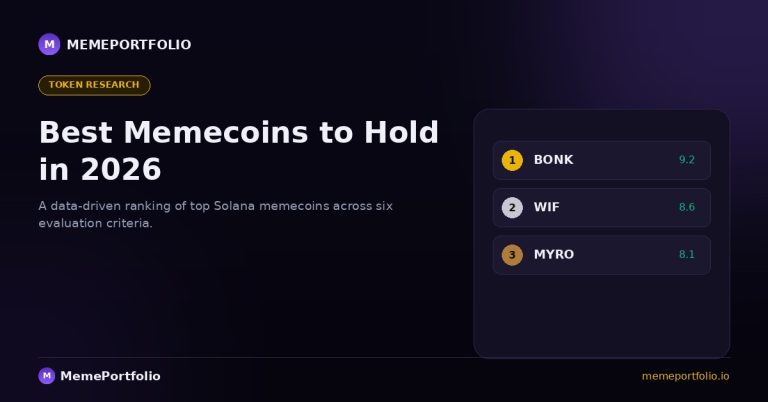
For comprehensive analysis of top Solana memecoins including scoring methodology, read our complete ranking guide.
Step 4: Determine Your Portfolio Size (How Many Tokens?)
Beginners often make two opposite mistakes: holding only one token (over-concentration) or spreading capital across 20+ tokens (over-diversification). Both reduce returns.
The Optimal Range: 3-7 Tokens
Why 3 minimum: Single-token portfolios expose you to company-specific risk. If that token’s developer disappears, community fractures, or narrative fades, your entire investment vanishes. Three tokens provide basic diversification against individual token failure.
Why 7 maximum for beginners: Beyond seven tokens, tracking becomes overwhelming and marginal diversification benefits diminish. You also face higher transaction costs from rebalancing many small positions.
Research from modern portfolio theory shows that 90% of diversification benefits come from the first 7-10 holdings in highly correlated asset classes.
Allocation by Portfolio Size
| Total Capital | Recommended Tokens | Strategy |
|---|---|---|
| $500-$1,500 | 3-4 tokens | Focus on established tokens, avoid micro-caps |
| $1,500-$5,000 | 4-6 tokens | Mix of stable + moderate risk tokens |
| $5,000-$25,000 | 5-7 tokens | Diversified across narratives and risk levels |
| $25,000+ | 6-10 tokens | Consider professional optimization (Markowitz) |
The Correlation Trap: Why 5 Dog Tokens Isn’t Diversification
Holding BONK, WIF, DOGE, SHIB, and FLOKI seems diversified—five different tokens. But all are dog-themed memes with highly correlated price movements. When dog memes fall out of favor, all decline together.
True diversification requires different narratives:
– One established large-cap (BONK)
– One viral pure meme (WIF)
– One utility-focused (MYRO)
– One gaming token (POPCAT)
– One cultural/charity token (MOODENG)
This structure provides actual uncorrelated exposure. Our Markowitz optimization article explains correlation analysis in depth with mathematical frameworks.
Step 5: Determine Initial Allocation Percentages
You’ve selected 5 tokens and have $5,000 to invest. How much goes into each? Equal-weight (20% each) seems logical but often proves suboptimal.
Beginner Allocation Strategies (Before Learning Optimization)
Strategy 1: Risk-Weighted Allocation (Recommended for Beginners)
Allocate more to established tokens with lower volatility, less to high-risk speculative plays. This balances upside potential with downside protection.
Example $5,000 allocation:
- BONK: 35% ($1,750) – Largest, most stable Solana memecoin
- MYRO: 25% ($1,250) – Moderate risk with utility
- WIF: 20% ($1,000) – Proven but volatile
- POPCAT: 12% ($600) – Speculative gaming play
- MOODENG: 8% ($400) – High-risk, high-reward cultural token
Rationale: Core position in BONK provides stability. Smaller allocations to volatile tokens limit damage if they crash while still capturing upside if they moon.
Strategy 2: Equal-Weight Allocation (Simple but Suboptimal)
Divide capital equally regardless of token characteristics. With 5 tokens, each gets 20% ($1,000 with $5,000 capital).
Pros: Simple to calculate and execute, no complex decisions needed, easy to track mentally.
Cons: Ignores volatility differences, gives equal weight to high-risk and low-risk tokens, typically underperforms risk-weighted approaches.
Strategy 3: Market-Cap Weighted (Follows Market Consensus)
Allocate based on relative market capitalizations. If BONK has 10x the market cap of POPCAT, it gets 10x the allocation.
Example calculation:
| Token | Market Cap | % of Total | Allocation |
|---|---|---|---|
| BONK | $800M | 50% | $2,500 |
| WIF | $400M | 25% | $1,250 |
| MYRO | $200M | 12.5% | $625 |
| POPCAT | $150M | 9.4% | $470 |
| MOODENG | $50M | 3.1% | $155 |
Pros: Follows market wisdom, established tokens get larger allocations automatically.
Cons: May overweight overvalued tokens, provides less exposure to high-growth smaller caps.
📊 Get Mathematically Optimal Allocations
Ready to move beyond basic allocation strategies? MemePortfolio.io calculates Markowitz-optimized percentages that maximize risk-adjusted returns based on correlation analysis and volatility data. Professional-grade optimization in 30 seconds.
Step 6: Execute Your First Purchases
With wallet secured, tokens selected, and allocations determined, you’re ready to buy. Execution matters—poor trade execution costs money through slippage and fees.
Buying on Decentralized Exchanges (DEXs)
Most Solana memecoins trade primarily on DEXs like Jupiter, Raydium, or Orca. These platforms let you swap SOL directly for any memecoin without KYC or account approval.
Step-by-step DEX purchase:
- Fund your wallet with SOL: Buy SOL on a centralized exchange (Coinbase, Kraken, Binance), then withdraw to your Phantom/Solflare wallet. Keep 0.1-0.2 SOL extra for transaction fees.
- Connect wallet to Jupiter Aggregator: Visit jup.ag and click “Connect Wallet.” Approve the connection request in your wallet extension.
- Enter swap details: Select SOL as input currency, choose your target memecoin as output. Enter amount to swap—start with your planned allocation for that token.
- Check slippage settings: For liquid tokens (BONK, WIF), 1-2% slippage works. Smaller tokens may need 3-5% to execute. Higher slippage means worse prices but better execution certainty.
- Review and confirm: Double-check token contract address matches official listings. Scam tokens with similar names exist. Confirm the trade in your wallet when prompted.
- Wait for confirmation: Solana transactions complete in seconds. Your new tokens appear in your wallet automatically.
Pro tip: Jupiter aggregates multiple DEXs to find best prices automatically. It often beats going directly to Raydium or Orca.
Buying on Centralized Exchanges (When Available)
Major memecoins like BONK and WIF list on centralized exchanges. If available, CEXs often provide better execution for larger orders.
Advantages of CEX purchases:
- Tighter spreads on high-volume pairs
- Limit orders available (buy at your target price)
- Easier fiat on-ramps (credit card, bank transfer)
- Familiar interface for traditional investors
Disadvantages:
- Not all memecoins listed (newer tokens only on DEXs)
- Must trust exchange custody (not your keys, not your coins)
- Withdrawal fees to self-custody wallet
- KYC requirements and account approval delays
Transaction Cost Management
Solana’s low fees make frequent trading viable, but costs still matter with small portfolios.
Typical cost breakdown for $1,000 purchase:
- Solana network fee: $0.00025 (negligible)
- DEX swap fee: 0.25% = $2.50
- Slippage on medium liquidity token: 1% = $10
- Total cost: ~$12.50 (1.25% of purchase)
Batching purchases reduces fees. Instead of 10 separate $100 buys ($125 total fees), make 2 $500 buys ($25 total fees).
Step 7: Track Performance and Monitor Your Portfolio
After purchasing, consistent tracking helps you make informed rebalancing and exit decisions. Don’t check prices hourly—that breeds emotional trading—but review weekly or monthly.
Essential Metrics to Track
Total portfolio value: Your starting $5,000 becomes $6,200 or $4,100 depending on market movements. Track absolute value, not just individual token prices.
Individual token performance: Which tokens are outperforming or underperforming? This informs future rebalancing decisions and helps identify winning strategies.
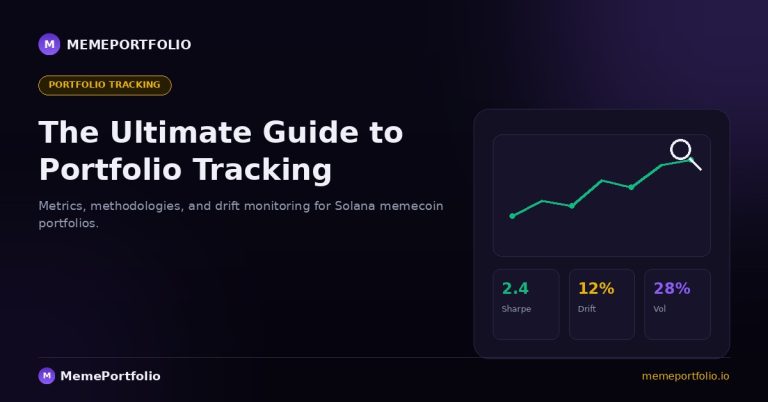
Allocation drift: If BONK was 35% initially but pumps to 50% of your portfolio, you’re overexposed. Our portfolio tracking guide explains optimal drift monitoring.
Unrealized gains/losses by position: Know your entry prices and current P&L for each holding. This matters for tax planning and exit strategies.
Tracking Tools and Methods
Manual spreadsheet tracking: Create a Google Sheet with columns for Token, Quantity, Entry Price, Current Price, Value, % of Portfolio. Update weekly. Free but time-consuming.
Portfolio tracking apps: CoinStats, Delta, or similar apps automatically pull wallet balances and calculate P&L. Convenient but requires wallet connection or manual entry.
Integrated portfolio management: MemePortfolio.io automatically tracks your holdings when you connect your Solana wallet, calculates real-time metrics, and shows allocation drift. Purpose-built for memecoin portfolios specifically.
Step 8: Know When and How to Rebalance
Markets move. Your carefully planned 35% BONK allocation becomes 50% after BONK doubles while other tokens stagnate. Rebalancing restores target allocations and forces systematic profit-taking.
Rebalancing Triggers for Beginners
Drift threshold method (Recommended): Rebalance when any token drifts >20% from target allocation.
Example: MYRO target is 25% of portfolio. It pumps to 38% (13 percentage points above target = 52% drift). Time to rebalance—sell some MYRO, buy underweight tokens.
Time-based method: Rebalance monthly regardless of drift. Simple calendar reminder approach. Works well for volatile memecoin markets where drift happens quickly.
Hybrid approach: Check monthly, but only rebalance if drift exceeds threshold. Reduces unnecessary trading while catching major imbalances.
How to Execute Rebalancing
Suppose your $5,000 portfolio grew to $7,000 with these drifted allocations:
| Token | Target % | Current Value | Current % | Action Needed |
|---|---|---|---|---|
| BONK | 35% | $2,100 | 30% | Buy $350 more |
| WIF | 20% | $2,450 | 35% | Sell $1,050 |
| MYRO | 25% | $1,750 | 25% | No change needed |
| POPCAT | 12% | $490 | 7% | Buy $350 more |
| MOODENG | 8% | $210 | 3% | Buy $350 more |
Execution: Sell $1,050 of WIF (overweight winner), use proceeds to buy $350 each of BONK, POPCAT, and MOODENG (underweight positions). This forces selling high and buying low systematically.
Our detailed rebalancing guide covers advanced techniques including tax-loss harvesting and volatility-based rebalancing.
🔄 Automate Your Rebalancing Analysis
Stop manually calculating rebalancing trades. MemePortfolio.io shows exact drift percentages, recommends specific buy/sell amounts, and recalculates optimal allocations as market conditions change. Get rebalancing recommendations in seconds, not hours.
Common Beginner Mistakes and How to Avoid Them
Learning from others’ mistakes costs less than making them yourself. These errors destroy beginner portfolios repeatedly.
Mistake #1: Chasing Pumps (FOMO Trading)
The pattern: Token pumps 200% in 24 hours. You see Twitter hype, feel left behind, buy at the peak. Token immediately dumps 60%. You’re down badly on a position entered purely from fear of missing out.
Why it happens: Social media amplifies winners. Nobody posts “my token stayed flat today.” You only see the pumps, creating false perception that everyone profits except you.
How to avoid: Stick to your predetermined buy list. If a token wasn’t good enough to research before the pump, it’s not worth buying during the pump. Wait for 40-50% corrections before considering entry.
Mistake #2: Panic Selling During Normal Corrections
The pattern: Portfolio drops 35% over three days. You sell everything “to preserve capital.” Market recovers the next week. You missed the bounce and locked in losses.
Why it happens: Memecoin volatility shocks new investors. A 30-40% correction feels catastrophic but is normal memecoin price action, not fundamental collapse.
How to avoid: Set stop-losses at reasonable levels (50-60% for memecoins, not 20%). Understand that volatility cuts both ways—accept drawdowns or avoid memecoins entirely. Our risk management guide covers position sizing that lets you survive corrections psychologically.
Mistake #3: Over-Diversification (Too Many Tokens)
The pattern: Hold 25 different memecoins with $200-300 in each. Can’t track them all. Several go to zero unnoticed. Transaction costs eat returns. Portfolio becomes unmanageable.
Why it happens: Belief that more tokens equals more safety. Confusing activity with progress. Fear of missing the “next BONK” so buying everything.
How to avoid: Stick to 3-7 quality tokens maximum. Focus beats spray-and-pray. Better to know 5 tokens deeply than 25 superficially.
Mistake #4: Ignoring Transaction Costs
The pattern: Rebalance daily, trade based on minor price movements, swap tokens frequently. Annual transaction costs reach 15-20% of portfolio despite “low” Solana fees.
Why it happens: Solana fees feel free ($0.00025 per transaction). Forgetting that swap fees (0.25-0.50%) and slippage (1-5%) add up quickly with frequent trading.
How to avoid: Rebalance monthly maximum. Set drift thresholds >15-20% before triggering trades. Batch transactions when possible.
Mistake #5: No Exit Strategy
The pattern: Token 10x from entry. You hold, planning to sell at 20x. Token retraces to 3x. You hold, waiting for it to pump back. Token slowly bleeds to breakeven. You still hold, hoping.
Why it happens: Greed during pumps (“why sell when it could 100x?”), hope during dumps (“it’ll recover”). No predetermined exit plan means emotions dictate decisions.
How to avoid: Set profit targets before buying. Example: sell 25% at 3x, 25% at 5x, 25% at 10x, hold remaining 25% for moon. Also set maximum loss limits: exit if position drops 60-70% from entry regardless of conviction.
Risk Management: Protecting Your Portfolio
Even perfect token selection fails without proper risk management. These principles keep you in the game long-term.
Position Sizing Rules
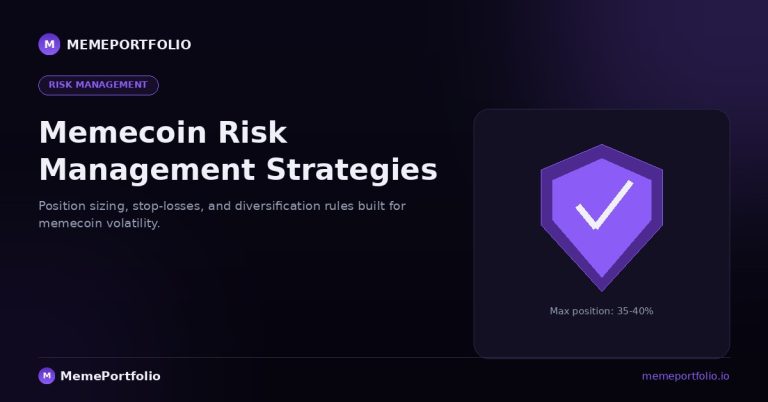
Maximum single position: 35-40% of memecoin portfolio. Even your highest-conviction play shouldn’t exceed this. Over-concentration destroys portfolios when that one token crashes.
Minimum position: 5-8% of portfolio. Smaller allocations become noise—not worth tracking and trading costs erode benefits.
Memecoin allocation within total portfolio: 5-20% maximum. According to asset allocation best practices, highly speculative assets should represent limited portions of total wealth.
Stop-Loss Strategy for Memecoins
Traditional 15-20% stop-losses don’t work with memecoin volatility—normal corrections trigger them constantly. Wider stops account for the asset class.
Recommended stop-loss levels:
- Established tokens (BONK, WIF): 50-60% from entry
- Mid-cap tokens (MYRO, POPCAT): 60-70% from entry
- Small-cap speculative: 70-80% from entry
Example: Buy MYRO at $1.00, set mental stop at $0.35 (65% loss). If it hits this level, exit regardless of conviction. This protects against complete blowups while allowing room for volatility.
Portfolio-Level Risk Metrics
Maximum portfolio drawdown tolerance: Decide beforehand what total portfolio decline triggers defensive action. Common thresholds: 40%, 50%, or 60% from peak.
Correlation monitoring: Track how your tokens move together. If all five pump and dump simultaneously, you don’t have real diversification. Consider swapping one for an uncorrelated narrative.
Volatility assessment: Calculate portfolio-wide volatility monthly. If it exceeds your comfort level, rebalance toward stable tokens or reduce position sizes.
Taking Your Portfolio to the Next Level
Congratulations—you’ve built your first memecoin portfolio! Most beginners never make it this far. You’ve selected tokens systematically, allocated capital thoughtfully, and implemented basic risk management.
Continuing Your Education
Master portfolio optimization: Basic allocation strategies work, but mathematical optimization delivers 20-40% better risk-adjusted returns. Learn Markowitz portfolio theory and correlation analysis through our complete optimization guide.
Advanced risk management: Move beyond basic position sizing to sophisticated techniques like Kelly Criterion, dynamic position sizing based on volatility, and systematic stop-loss strategies. Our risk management article covers advanced methods.
Systematic rebalancing: Understand optimal rebalancing frequencies, drift thresholds, tax-loss harvesting, and volatility-based rebalancing through our rebalancing guide.
Professional Portfolio Tools
Manual tracking and calculation works initially. As your portfolio grows, professional tools save hours while delivering better results.
What professional optimization provides:
- Automated correlation analysis across all holdings
- Markowitz-optimized allocations updated continuously
- Real-time drift monitoring with rebalancing alerts
- Risk metrics calculated automatically (Sharpe ratio, volatility, max drawdown)
- Exact trade amounts for rebalancing (not rough estimates)
MemePortfolio.io builds these capabilities specifically for Solana memecoin portfolios. Connect your wallet for instant analysis—no spreadsheets, no manual calculations, no programming required.
Conclusion: Your Action Plan This Week
You now understand the complete portfolio-building process from first dollar to ongoing management. Knowledge means nothing without execution. Here’s your week-one action plan.
Day 1-2: Secure your foundation
- Set up Phantom or Solflare wallet
- Write down seed phrase physically, store securely
- Test with small SOL transfer ($10-20)
- Enable all security features
Day 3-4: Research and select tokens
- Review our best memecoins guide for current rankings
- Check community strength, tokenomics, liquidity for 10-15 candidates
- Narrow to your final 3-5 tokens
- Document your selection rationale (helps maintain discipline later)
Day 5-6: Execute initial purchases
- Calculate allocation percentages using risk-weighted method
- Buy your first 2-3 tokens on Jupiter or CEX
- Document entry prices and quantities
- Set up tracking spreadsheet or app
Day 7: Set up ongoing processes
- Calendar reminder for monthly portfolio review
- Connect wallet to MemePortfolio.io for automatic tracking
- Set profit targets and stop-loss levels for each position
- Plan first rebalancing check (30 days out)
Remember: This is a marathon, not a sprint. Building wealth through memecoins requires discipline, systematic processes, and emotional control. Start small, learn continuously, and compound your knowledge alongside your capital.
Your first portfolio will have flaws—everyone’s does. You’ll make mistakes, experience FOMO, panic during corrections. That’s normal and expected. The key is learning from each mistake and improving your process iteratively.
Welcome to memecoin investing. Now go build your portfolio.
About MemePortfolio.io
MemePortfolio.io is the first portfolio optimization platform built specifically for Solana memecoin investors. Using advanced Markowitz optimization algorithms, real-time correlation analysis, and comprehensive risk metrics, the platform automates complex portfolio mathematics. Connect your Solana wallet for instant portfolio analysis, optimization recommendations, and automated rebalancing guidance. Transform hours of manual calculation into seconds of automated analysis. Github, Medium, Twitter.
Disclaimer: This article is for informational and educational purposes only and does not constitute financial or investment advice. Memecoin investments are highly speculative and volatile. Only invest capital you can afford to lose completely. Past performance does not indicate future results. Always conduct your own research and consider consulting with a qualified financial advisor before making investment decisions. The author and platform may hold positions in mentioned tokens.